
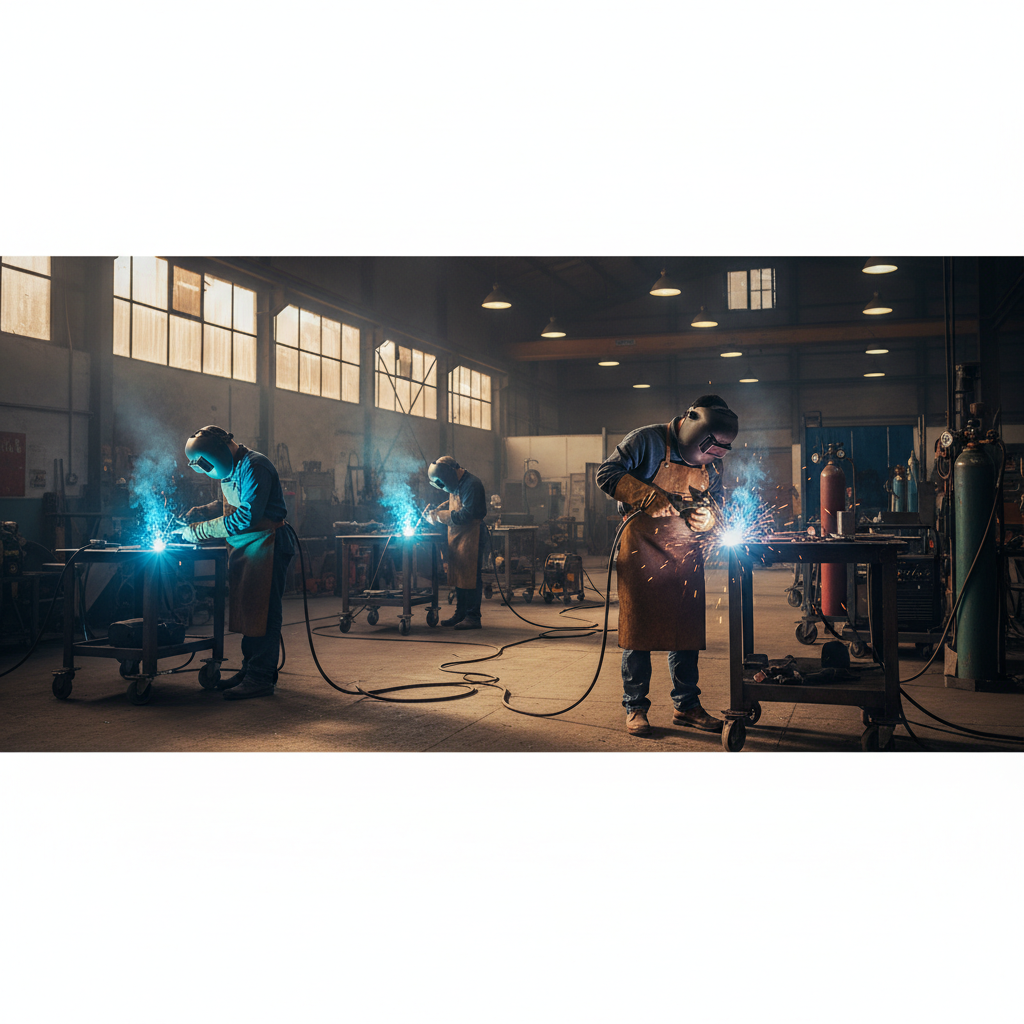
Choosing the right welding process affects not just the quality of your welds but the cost and speed of your operation. MIG, TIG, and stick welding each serve different purposes, and the right choice depends on your specific application, materials, and environment.
MIG Welding: The General-Purpose Workhorse
MIG (Metal Inert Gas) welding is the most versatile process and the easiest to learn. It uses a continuous wire electrode and shielding gas to produce clean, consistent welds on steel, stainless, and aluminum. For production welding and general fabrication, MIG is the go-to choice. Setup is straightforward and the process produces minimal spatter when parameters are dialed in correctly.
TIG Welding: Precision and Quality
TIG (Tungsten Inert Gas) welding produces the highest-quality welds with superior aesthetics and precise control. It's the process of choice for aerospace, automotive, and food-grade applications where appearance and weld integrity are critical. TIG requires more skill than MIG — the operator controls the torch, filler rod, and amperage simultaneously. The payoff is exceptional weld bead appearance and minimal spatter.
Stick Welding: Field-Ready Strength
Stick (Shielded Metal Arc Welding) is the most rugged and portable process. It works on rusted or painted metal, outdoors in wind, and on thick material in any position. Stick electrodes are inexpensive and the equipment is bulletproof. For field repair, structural welding, and heavy plate, stick welding remains indispensable despite its slower travel speed and more complex post-weld cleanup.